
Social Media Content Experimentation: Find What Works in 2026
Learn how to test social media content, identify winning patterns, and improve your strategy using data-driven content experimentation in 2026.
Kasthuri| 24 Aug 2026

Most brands are still guessing. They post, check the numbers a day later, feel good or bad about it, and move on. That’s not a strategy — it’s a mood ring.
Content experimentation is different. It’s a repeatable system: test one variable at a time, measure it against a real goal, and let the data — not your gut — decide what goes into your regular content mix. Heading into 2026, algorithms are more sophisticated, formats keep multiplying, and audiences expect more personalized, relevant content than ever, which means the brands still relying on instinct alone are falling behind the ones running social like a research function (Crescitaly, 2026).
This guide walks through how to build that system from scratch — what to test, how to test it fairly, how to read the results, and how to turn a single winning post into a lasting improvement in your content strategy.
Why “Post and Hope” Doesn’t Work Anymore
Platforms change their algorithms constantly, formats fall in and out of favor within a season, and audience expectations keep rising. What performed six months ago can flatline today. The best social teams have started treating their channels less like a broadcast tool and more like a research engine — a place to collect first-party signal, spot micro-shifts in sentiment, and test creative variables quickly, adjusting before a trend peaks rather than after (Hootsuite, 2026).
That shift matters because vanity metrics like follower counts are becoming less useful signals of success. What matters more is audience behavior — saves, replies, watch time, and the actions that show someone actually engaged with what you made, not just scrolled past it (Slate, 2026).
The fix isn’t posting more. It’s testing smarter, and doing it consistently enough that you build a real picture of what your specific audience responds to — because what works for another brand in your category won’t necessarily work for yours.
What Content Experimentation Actually Means
At its core, content experimentation applies the same logic as classic A/B testing to your social channels: publish two versions of a post that differ in exactly one way, then compare how each one performs against a metric you defined in advance (Hootsuite Beginner’s Guide, 2026).
On paid social, this is straightforward — most platforms include native testing tools that split your audience for you. On organic social, it’s messier, since you can’t guarantee a clean, randomized split of who sees each version. That’s fine. You compensate with discipline: consistent posting conditions, a single variable, and enough patience to let the data accumulate before you call a winner.
The goal isn’t to “win” any single post. It’s to build a body of evidence, post after post, about what reliably works for your brand’s specific audience — so your content decisions get better over time instead of resetting to zero every week.
Step 1: Set One Clear Goal Before You Test Anything
Every experiment needs a single primary metric, decided before you publish anything. Trying to improve reach, engagement, and conversions all at once with one test just produces noise you can’t interpret.
Pick the metric that matches the content’s job:
- Brand awareness content → reach, average watch time
- Community-building content → comments, saves, shares, DMs
- Conversion-focused content → link clicks, sign-ups, sales, discount code redemptions
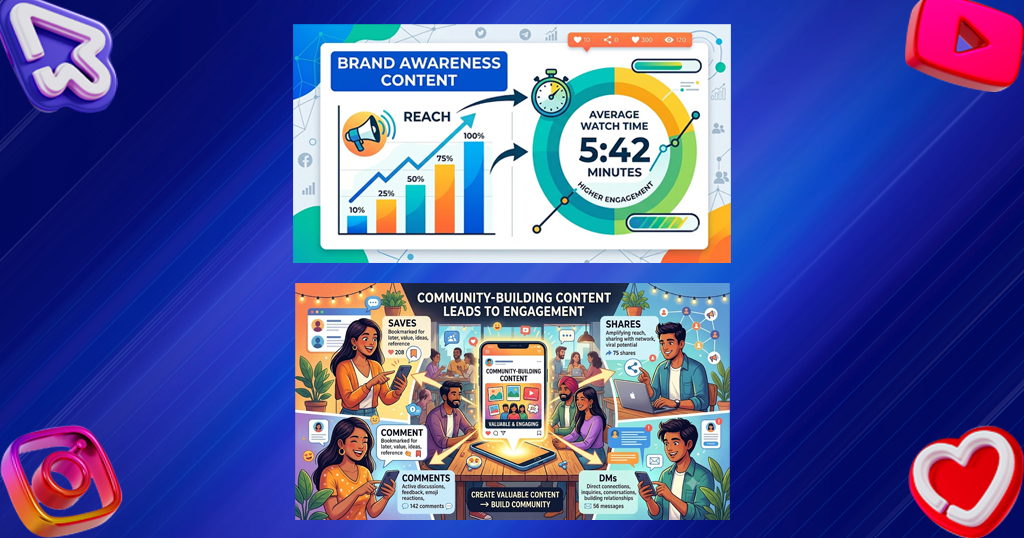
This mirrors how broader content marketing strategy should work too — track metrics like traffic, engagement, and lead generation, and use what you learn to refine your approach over time rather than treating every post as a one-off (Storefries: Content Marketing for Small Business).
Write the goal down. “We’re testing whether shorter captions increase saves on product Reels” is a testable hypothesis. “Let’s see what happens” is not.
Step 2: Pick a Single Variable to Test
The entire discipline of experimentation lives or dies on this rule: change one thing at a time. If you swap the hook, the visual, and the posting time all in the same test, you’ll never know which change actually moved the needle. This is the same single-element-testing principle driving the current wave of rapid, hyper-speed creative testing across social teams — old-school A/B logic, just applied faster and more often (Hootsuite Trends, 2026).
Good first variables to isolate:
- Hook or opening line
- Caption length or tone
- Thumbnail or first-frame visual
- CTA wording or placement
- Posting time or day
- Content format (Reel vs. carousel vs. static)
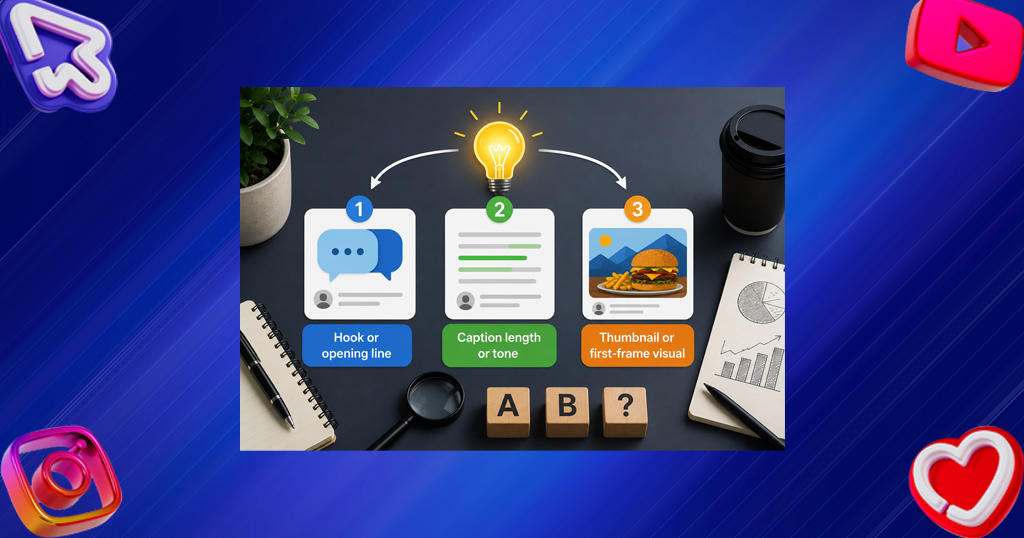
Keeping every other element constant is what lets you trust the result. Change two things and a “win” might just be luck.
Step 3: Design a Fair Test
For paid content, use your platform’s built-in experiment tools. On Meta, that means the Experiments tool inside Ads Manager — choose the variable you want to test (creative, audience, or placement), build two versions that differ only in that variable, and let the platform randomize exposure for you (Brandwatch, 2026).
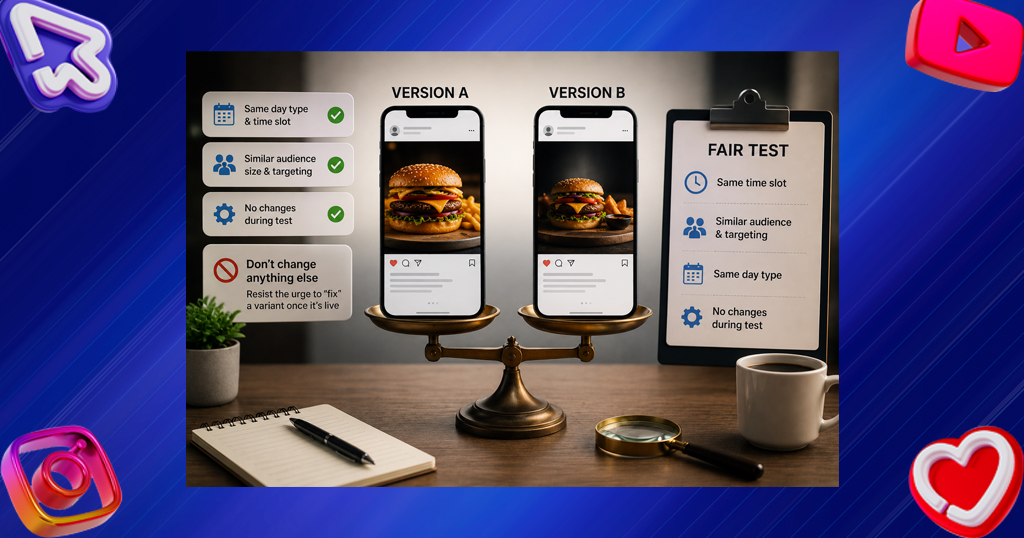
For organic content, you won’t get a clean 50/50 split, so compensate with tighter controls instead:
- Publish both versions under similar conditions (same day type, similar time slot)
- Keep audience size and targeting as close to identical as possible
- Don’t change anything else mid-test — resist the urge to “fix” a variant once it’s live
- If timing itself is your variable, publish both at the intended times rather than simultaneously — otherwise you’ve accidentally introduced a second variable
Step 4: Let the Test Run Long Enough to Mean Something
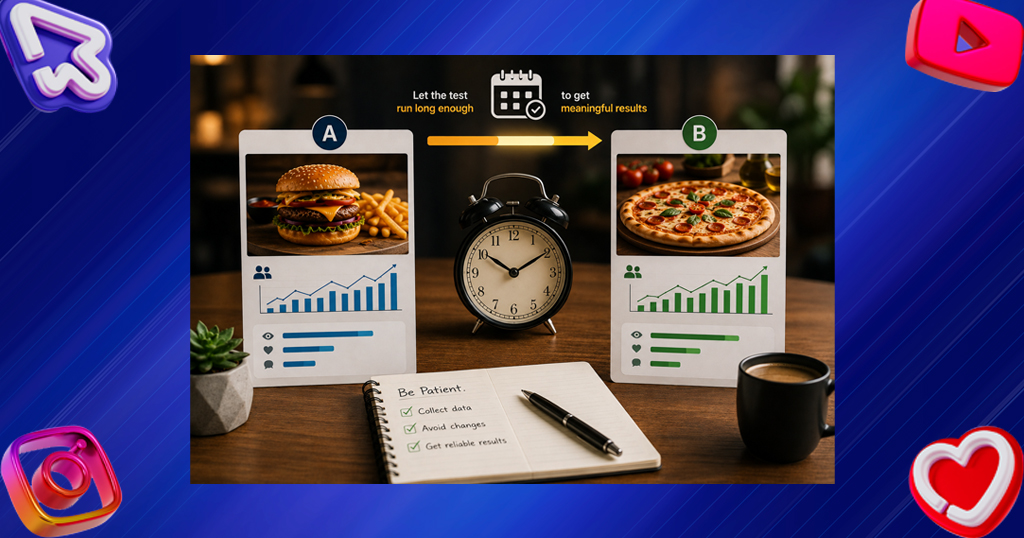
A test that runs for three hours before you declare a winner isn’t a test — it’s a coin flip. Once your variants are live, sit on your hands: don’t touch anything until the test window closes, and then gather the results in one place before comparing them (Emplifi, 2026).
Give each variant enough time and enough impressions to reduce noise, especially for organic content where sample sizes are naturally smaller and less controlled than paid. As a rule of thumb, don’t call a result until you have a comparable volume of engagement or impressions on both variants, not just a comparable number of days live.
Step 5: Read the Results the Right Way
Once the test window closes, pull the numbers into one place and compare them against your single primary metric from Step 1 — not every metric that happens to look interesting.
Ask:
- Did the winning variant actually beat the baseline by a meaningful margin, or is the gap small enough to be chance?
- Could the result simply have happened by chance — is it worth checking for statistical significance before you act on it (Emplifi, 2026)?
- Does the result hold across the audience segments you care about, or is it skewed by one outlier post?

If the answer is genuinely unclear, that’s a valid outcome too. Not every test produces a decisive winner, and forcing a conclusion from a noisy result is worse than admitting it was inconclusive.
Step 6: Roll the Winner Into Your Content Pillars
A test result is only useful if it changes what you actually publish. Once you’ve identified a winning variant:
- Scale it — give it more budget or a heavier organic push, and implement the winning version into your regular content strategy and campaigns going forward (Sprinklr, 2026)
- Document it — record what was tested, the performance metrics, and the insight gained, so the finding doesn’t live only in one person’s memory (Sprinklr, 2026)
- Plan the next test — either refine the winner further or move to a new variable, before creative fatigue sets in and the winning format starts to flatten out

AI-powered analytics tools are increasingly able to go beyond “what won” to explain the recurring creative pattern behind why something performed well, by analyzing recurring elements across a large volume of content rather than judging posts one at a time (Hootsuite Trends, 2026). If your platform surfaces this kind of pattern analysis, it’s worth reviewing — it can point you toward your next hypothesis instead of a random guess.
What to Test First: 6 High-Impact Variables
If you’re starting from zero, don’t try to test everything at once. Work through these in order — each one tends to move the needle more than the last on most brand accounts:
- Hook/first 3 seconds — the single biggest lever for video retention
- Thumbnail or cover image — determines whether static and carousel posts get a click at all
- Caption length — short, punchy captions vs. longer storytelling captions
- CTA wording — “Shop now” vs. “See how it works” vs. no CTA at all
- Posting time — test your two or three most plausible windows rather than every hour of the day
- Format — Reel vs. carousel vs. single image, holding the message constant
Platform-by-Platform Testing Notes
Every platform’s algorithm rewards slightly different signals, so the same test can produce different “winners” depending on where you run it. Understanding what each platform’s algorithm actually prioritizes — relevance, personalization, and participation, for instance — helps you interpret results in context rather than assuming one platform’s winner will automatically translate to another (Storefries: Social Media Algorithm Guide).
A few practical notes:
- Instagram & short-form video: hook and first-frame visual tend to have outsized impact on whether a Reel gets watched at all
- X (Twitter): consistency and topical alignment with your niche matter for visibility, so format tests should hold topic constant (Storefries: Twitter Algorithm Guide)
- Scheduling tools: if you’re testing posting times or frequency, a scheduler that shows engagement by time slot makes it much easier to spot a real pattern instead of eyeballing a feed (Storefries: Best Instagram Schedulers)
How to Track Results Without Losing Your Mind
Experimentation only compounds into a real advantage if you’re actually watching the data as it comes in — not just at the end of a campaign. Real-time monitoring lets you catch a clear trend early, adjust before you’ve wasted budget or a full week of organic reach, and spot sentiment shifts that a delayed weekly report would miss entirely (Storefries: Social Media Monitoring Guide).
A simple, repeatable tracking setup:
- One shared doc or dashboard per test, logging the hypothesis, the variable, the date range, and the result
- A short “what we learned” line for every test — even inconclusive ones — so the next person doesn’t repeat it
- A running list of “next tests to run,” so you always have a queue instead of starting from scratch each week
Common Mistakes That Ruin an Experiment
- Testing too many variables at once — you’ll get a result, just not one you can trust
- Ending the test too early — a slight lead after 24 hours often reverses by day three
- Chasing vanity metrics — a high-reach post that drives zero saves or clicks isn’t a win if your goal was conversion
- Never documenting results — without a record, teams re-run the same tests every few months without realizing it
- Treating one win as permanent — audience behavior shifts; a hook that worked last quarter needs to be re-tested, not assumed
- Ignoring platform differences — a caption length that wins on LinkedIn won’t necessarily win on Instagram
Build Experimentation Into Your Weekly Workflow
The brands that benefit most from this aren’t running one big test a quarter — they’re running small, structured tests every week as a habit, the same way they’d check any other performance number.
That’s easiest to sustain with a system that lets you plan, publish, and compare content performance from one place instead of piecing results together across five different platform dashboards. Storefries’ analytics and scheduling tools are built for exactly this — plan your variants, publish on a consistent schedule, and see what’s actually working without jumping between apps.
Start your free 14-day trial today and turn your next content decision into a tested one instead of a guess.
FAQ
1. How long should a social media content test run?
Long enough to gather a comparable volume of engagement or impressions on both variants — not just a comparable number of days. A quiet weekend and a busy Monday aren’t equivalent test conditions, so judge by data volume, not the calendar.
2. Can I A/B test organic posts, or only paid ads?
Both, but organic tests need tighter manual controls since you can’t randomize who sees each version the way paid platforms do. Match posting time, day type, and audience as closely as possible instead.
3. What’s the single best variable to start testing first?
For most brands, the hook or first three seconds of a video and the thumbnail on static posts have the biggest impact on whether content gets seen at all — start there before testing caption tone or CTA wording.
4. How do I know if a test result is real or just noise?
Check whether the gap between variants is large enough to hold up, not just a few percentage points that could be chance. If you’re running paid tests, many ad platforms will flag statistical significance for you automatically.



Leave A Comment